

Interview with Lt. Gen. Robert L. Van Antwerp, Jr., P.E., D.WRE
February 2010
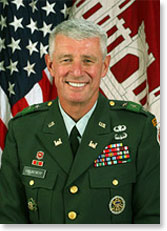
Lieutenant General Robert L. "Van" Van Antwerp is the current U.S. Army Chief of Engineers and Commanding General of the U.S. Army Corps of Engineers (USACE). General Van serves as the senior military officer overseeing most of the Nation's civil works infrastructure and military construction.
As the USACE Commanding General, LTG Van is responsible for approximately 36,000 civilian and 600 military employees, who provide project management and construction support to 250 Army and Air Force installations in nearly 100 countries around the world. USACE has a key role in support to Overseas Contingency Operations, with thousands of Civilians and Soldiers deployed to support reconstruction in Iraq and Afghanistan. General Van is also responsible for hundreds of environmental protection projects and for overseeing the regulatory permit program to protect, restore and enhance thousands of acres of wetlands. In addition, USACE has an emergency response mission to support the Federal Emergency Management Agency in restoration and repair after a disaster, whether natural or manmade.
General Van took command of USACE after serving, most recently, as Commanding General, U.S. Army Accessions Command, responsible for recruiting and training thousands of young patriots who represent the epitome of "Army Strong."
Other command assignments include the U.S. Army Maneuver Support Center and Fort Leonard Wood; Commandant, U.S. Army Engineer School, Fort Leonard Wood, Missouri; U.S. Army Corps of Engineers, Los Angeles District during the Northridge Earthquake of 1994; the U.S. Army Corps of Engineers, South Atlantic Division, Atlanta, Georgia; and the 326th Engineer Battalion, 101st Airborne Division (Air Assault) during Operation Desert Shield and Operation Desert Storm in Saudi Arabia and Iraq.
A graduate of the U.S. Military Academy at West Point in 1972, General Van completed Ranger, Airborne and Air Assault training, and both the Engineer Officer Basic and Advanced Courses. He holds a Master of Science degree in Mechanical Engineering from the University of Michigan and a Master of Business Administration degree from Long Island University in New York. He is a Registered Professional Engineer.
Lt. Gen. Van Antwerp was bestowed a special AAWRE recognition award at the 2009 EWRI Congress for his service to the nation and for his contributions to the engineering profession. He was also bestowed the Diplomate status in 2009.
Five Fun Facts
Most fun class while in school:
Middle School: Gym; High School: Algebra; College: Mechanics of Materials.
My source for inspiration:
My Father: Family man; Soldier WWII; Mechanical Engineer; Inventor; Boater, Business Man, Leader.
An item or something I always wanted:
A wonderful wife and family. I married Paula, the love of my youth (37years ago); we have five great kids and five grandchildren (so far). I'm blessed to have what I always wanted.
Favorite song & artist:
Unchained Melody by the Righteous Brothers.
Favorite movie:
Any John Wayne Western; the Sting w/Robert Redford; Christmas Vacation w/Chevy Chase.
Please share with us on where most of your childhood was spent?
RVA: I grew up on the shores of Lake Michigan...boating, skiing, swimming, hockey, working on cars, playing all sports.
What was it like for you during your school years?
RVA: It was great growing up and going to school. I actually liked school- had great friends and excellent teachers. I played basketball, football and tennis, and learned the value of being a member of a team. Academics came easy - especially math and science. I met my wife in high school at the age of 16.
We understand that you are a proud graduate of the U.S. Military Academy. Did you know early on that you wanted to be at the U.S. Military Academy and how was the path for you?
RVA: I didn't know much about the Academy in high school. I was recruited to play football. When I got there, I found it to be a great fit. I came from a home that modeled and stressed hard work and personal discipline...perfect for West Point. The Academy set the foundation for leadership that would help me throughout my career.
We know that you attended the University of Michigan as a Mechanical Engineering major and achieved an MBA later on. What were the early influencing factors in your decision to pursue mechanical engineering and then pursue an MBA?
RVA: My father was a mechanical engineer and I just naturally wanted to follow in his footsteps. I studied engineering at West Point and was later selected to return on the faculty and teach Mechanical Engineering. They gave me the choice of schools and I chose Michigan - GO BLUE! I started my MBA while at Michigan and finished at Long Island University. I felt that the MBA complemented the engineering degree. Thought I might start my own business someday, like my dad. Little did I know my "business" would be all in the Army...
We sincerely thank you for all of your service to our nation and our military- having served during Operation Desert Shield and Operation Desert Storm in Saudi Arabia and Iraq. Can you share with us- folks that may have not served in the military on what the experiences were like defending and fighting in wars?
RVA: During Desert Storm I was a commander of an engineer battalion consisting of about 650 Soldiers. I was privileged to have wonderful leaders above me, beside me and serving under me. The camaraderie in our unit was very special. We were well trained and knew our mission - mobility, counter-mobility, survivability. We all felt it was a privilege to serve our nation and fight for the oppressed. When we crossed the line of departure into Iraq, the adrenaline was really flowing. In the end, you just want to do your job well so you don't let your fellow Soldiers down. I love being around people that put service above self... that's the Army. Soldiers sacrifice a lot, and in war you see courageous acts everyday.
How different do you feel the two current wars in Afghanistan and Iraq are from Operations Desert Shield and Desert Storm?
RVA: DS/DS was 100 hrs. OIF/OEF are long wars; 8+ years, with all elements - offense, defense, stability, and reconstruction. In many ways, OIF/OEF are more dependent on engineers because of our role in stability operations and reconstruction. It has honed our tactical and construction skills.
We understand that the USACE is playing a key role in the reconstruction efforts in Iraq and Afghanistan, by supporting the Overseas Contingency Operations, with thousands of Civilians and Soldiers deployed to help. Can you tell us what some of the biggest challenges are in those efforts and how the reconstruction efforts are progressing at present time?
RVA: There are many challenges but the biggest is related to having adequate security on the many job sites and construction projects so we can put eyes on and deliver quality construction. Reconstruction is progressing well in both theaters. We have more than 1,000 USACE teammates deployed. Afghanistan reconstruction will top $3 billion this year.
We know that the American Recovery and Reinvestment Act of 2009 (ARRA) appropriated $4.6 billion to the USACE for its Civil Works program and this enables the USACE (according to a list prepared in April 2009) to work on approximately 172 construction projects, 523 Operation and Maintenance projects, 45 Mississippi River and Tributaries projects, 64 Investigations projects, and nine projects under the Formerly Utilized Sites Remedial Action Program (FUSRAP). How significant do you feel the impact of ARRA has been on the USACE Civil Works programs, and have the numbers in these projects changed?
RVA: ARRA has been a significant part of our program this past year. (Your numbers are about right.) Between Civil Works, Military Programs, and Work for Others, the program totals nearly $9 billion of a $45 billion program. It has enabled us to create jobs, stimulate, the economy and take care of some of the maintenance backlog on our aging facilities. The average age of our 241 locks is 58 years old. So this has been a great opportunity to tackle some major infrastructure challenges.
In looking back over the last few years since being the Commanding General of the U.S Army Corps of Engineers, would you share with us about some of the more memorable moments as serving as Commanding General that truly stand out?
RVA: It has been a privilege to lead this wonderful organization. I have seen the team in New Orleans tackle a $15 billion program to help the people of Louisiana recover from Hurricanes Katrina and Rita. We have tackled a $20+ billion program of Base Realignment and Closure on Army and Air Force bases and built new facilities to provide for a growing Army. In Korea, our Far East District is working a $12 billion program to relocate the peninsula force at Garrison Humphries.
Which issues, topics, or projects (if any) did you personally feel were most challenging to deal with as Commanding General of 36,600 USACE employees? And most fun or memorable?
RVA: We have set the Corps on a course to go from Good to Great by getting the right people (we recruited 8,213 last year), establishing a "campaign plan" with a solid vision and mission, and are executing with disciplined action. We had a record year last year with $45 billion under contract. We have a great mission and purpose and watching the men and women of the Corps tackle it has been both fun and memorable.
We know that you are a very busy person, sir. What is a typical day like for you?
RVA: After 2+ years, I think I've found a good battle rhythm that balances family, work, recreation, and church activities. I travel about half the time. I want to see our districts and divisions on their home turf and meet as many teammates as I can. The challenge is not to get overwhelmed by the "tactical" and spend sufficient time on the strategic issues.
When in DC, I start the day with a workout, devotional time, prayer and breakfast with my wife at home... into the office by 8am, get updates on operations, meet with senior leaders on key issues, often attend staff meetings in the Pentagon, work correspondence and email, walk around talking to teammates, and leave by 5pm... (Of course I'm always on email - I'm a blackberry junky).
What do you personally feel are the biggest challenges that are on the horizon for the USACE and civil engineering profession?
RVA: One of the big challenges we are attacking is building engineer competency for the challenges of tomorrow. For example: We know we are going to rehab many of our locks and dams and need the expertise.
Our colleges and universities are not graduating enough engineers and scientists so we are getting into the middle schools and high schools to excite students about engineering.
What would be your advice to young students and kids out there whom are interested in seeking a life serving in the U.S. Military?
RVA: If you want an adventure with a purpose, join up. We've moved 22 times and been privileged to serve all over the country and world. Our children are strong and adaptable and have loved the military way of life. Our 3 boys have all served and 1 of our daughters is married to a Soldier.
The Army has provided an opportunity for graduate education and incredible leadership training and opportunity. We wouldn't change a thing.
We have witnessed your speeches and talks. We sincerely enjoyed listening to your keynote address at last year's EWRI Congress in Kansas City. What is your personal formula for a successful presentation to an audience?
RVA: I love people and I like to be interactive with the audience- get them involved and thinking along with me. The best speakers I know are great story tellers so I try to mix stories in that make the point or emphasize what I want to get across.
I start with a simple message of 3 or 4 things I want to get across then build around those things using personal and other examples to add clarity.
We've heard a bit on your personal leadership philosophy. One of your aides shared with us a great metaphor that you like to utilize regarding 'walnut and rice' in a jar. Can you share with us more on this and your personal vision on leadership and management?
RVA: I talk about our "Walnut and Rice" jar in the context of setting "priorities". If you put the walnuts (the important things) in first, the kernels of rice fit neatly around them. If you reverse the order, the walnuts won't fit and you'll spend most of your time on the less important things.
I always focus on people first... getting disciplined people. They will go to work and find better ways to do business (disciplined thought and action). It starts with getting great people. I've always felt that people have to buy into you before they will buy into where you want to take them.
We understand your employees and others call you General Van or simply "Van". We can correlate how this came about but how did it stick?
RVA: I'm a junior - Robert, Jr. - and everyone called my Dad "Bob," so they called me "Van" to eliminate confusion. It stuck. I like things informal, familiar and friendly. I call everyone I know in our organization by their first name and encourage informality... everyone is important and contributes to the mission.
What are some of your personal hobbies and interests?
RVA: I love being with family. We all went to Disney World this Christmas and had a ball. We have a speedboat in North Carolina and love to ski and go tubing. All of us play tennis and we have big, knock down, drag out tournaments. I also love to ride my motorcycle every chance I get.
What are some of your personal goals and wishes for the next year?
RVA: I have a little over a year left. I want to finish strong and keep the organization moving in the right direction - from Good to Great. I think we have an excellent plan on how to get there. We are building our bench and strengthening competencies in all areas.
We will keep the focus on bringing the right people in (we need another great recruiting year of about 8,000) and on "execution". In the end, we will be judged by the quality of our projects. We will also keep a strong focus on innovation.
Personally, I want to keep the balance, stay fit, keep learning the business, and encourage the team to reach for the stars.
American Academy of Water Resources Engineers
1801 Alexander Bell Drive, Reston, VA 20191 USA
Phone:703-295-6414 Fax:703-295-6415
E-mail:[email protected]